
EXHIBIT 99.2
Impact of Middle East conflict on ExxonMobil activities
SPRING, Texas – April 8, 2026 – ExxonMobil is providing this supplement to its first-quarter Earnings Considerations disclosure in light of the ongoing situation in the Middle East and related disruptions.
First-quarter earnings per share are expected to be higher than the fourth quarter of 2025, excluding unfavorable timing effects that will reverse over time.
Upstream
The Middle East assets represent approximately 20% of our global oil-equivalent production, but a smaller percentage of Upstream earnings.
Certain assets in Qatar and the UAE in which ExxonMobil holds ownership interests experienced production disruptions beginning in March. As a result, the Company expects Middle East disruptions to lower global oil-equivalent production by approximately 6% in first quarter compared with fourth-quarter 2025.
In Qatar, attacks in the first quarter impacted two LNG trains in which ExxonMobil has ownership interest. These assets accounted for approximately 3% of 2025 Upstream production. Public reports indicate the damage will take a prolonged period to repair. Pending an on-site evaluation, we are unable to comment on the length of time before the two trains return to normal operations.
Below is a summary of ExxonMobil Upstream investments in the Middle East region together with selected 2025 operating data.
| Middle East - Upstream | ||||||||||||||
| Working Interest | ExxonMobil Share | |||||||||||||
2025 Liquids (kbd) | 2025 Gas Available for Sale (Mfcd) | 2025 Net Oil Equivalent Barrels (koebd) | ||||||||||||
| Qatar | ||||||||||||||
| LNG Joint Ventures | 24-30% | 147 | 2,888 | 628 | ||||||||||
| Al Khaleej Gas | 80-100% | |||||||||||||
| Barzan | 7% | |||||||||||||
| UAE | ||||||||||||||
| Upper Zakum | 28% | 312 | 312 | |||||||||||
Product Solutions
The Middle East assets represent approximately 5% of our global refining and chemical capacity.
The Company expects Middle East disruptions and reduced crude availability at Asia Pacific operations to lower global Energy Products throughput by approximately 2% in first quarter compared with fourth-quarter 2025.
Below is a summary of ExxonMobil Product Solutions investments in the region together with selected 2025 operating data.
Capacity At Year-End 2025 1 | |||||||||||||||||||||||||||||
| ExxonMobil Interest % | ExxonMobil’s Share of Refining Capacity 2 | Ethylene | Polyethylene | Polypropylene | |||||||||||||||||||||||||
| (thousands of barrels daily) | (millions of metric tons per year) | ||||||||||||||||||||||||||||
| Middle East | |||||||||||||||||||||||||||||
| Al Jubail | Saudi Arabia | ▲ | ● | 50 | — | 0.7 | 0.7 | — | |||||||||||||||||||||
| Yanbu | Saudi Arabia | ■ | ● | 50 | 200 | 1.0 | 0.7 | 0.2 | |||||||||||||||||||||
| Total Middle East | 200 | 1.7 | 1.4 | 0.2 | |||||||||||||||||||||||||
■ Energy Products ▲ Specialty Products ● Chemical Products | |||||||||||||||||||||||||||||
1 ExxonMobil share reflects 100 percent for operations of ExxonMobil and majority-owned subsidiaries. For companies owned 50 percent or less, ExxonMobil share is the greater of ExxonMobil’s interest or that portion of distillation capacity normally available to ExxonMobil.
2 Refining capacity data is based on 100 percent of rated refinery process unit stream-day capacities to process inputs to atmospheric distillation units under normal operating conditions, less the impact of shutdowns for regular repair and maintenance activities, averaged over an extended period of time. The listing excludes refining capacity for a minor interest held through equity securities in the Laffan Refinery in Qatar for which results are reported in the Upstream segment.
1
Timing effects
Physical shipments of hydrocarbons and finished products are often hedged using financial derivatives in the normal course of business. At the end of each quarter, accounting standards require open financial derivatives to be marked to current period-end prices (typically referred to as “mark to market”) with the corresponding value reflected in current period earnings. The associated physical shipments are not marked to current period-end prices but valued on the balance sheet in inventory based on LIFO accounting rules. As a result, unlike the financial derivatives, the value of the physical shipment is not reflected in earnings until the transaction is complete. This mismatch between the valuation of the financial derivatives and the associated physical transaction results in a timing difference in earnings that unwinds over subsequent quarters consistently delivering a net profit. LIFO valuation also drives timing differences between the accounting recognition of the settlement of the derivatives and their offsetting physical shipments. Together, these are referred to as timing effects.
In periods of rising prices, the timing effects are typically negative, while in periods of decreasing prices, the timing effects are typically positive. Importantly, excluding timing impacts, these trading and optimization activities have consistently delivered positive earnings to the Corporation.
Timing effects vary quarter-to-quarter following the movement and magnitude of prices. The exhibit below provides the Brent price on the last day of each quarter over the last three years, and the resulting quarterly timing effects reflected in earnings.
| Quarter-end Brent Price 3 | ||||||||||||||||||||||||||||||||||||||||||||
| 1Q23 | 2Q23 | 3Q23 | 4Q23 | 1Q24 | 2Q24 | 3Q24 | 4Q24 | 1Q25 | 2Q25 | 3Q25 | 4Q25 | |||||||||||||||||||||||||||||||||
| 80 | 75 | 92 | 77 | 87 | 85 | 72 | 74 | 75 | 67 | 66 | 60 | |||||||||||||||||||||||||||||||||
Quarter Timing Effects (millions of dollars) 4 | ||||||||||||||||||||||||||||||||||||||||||||
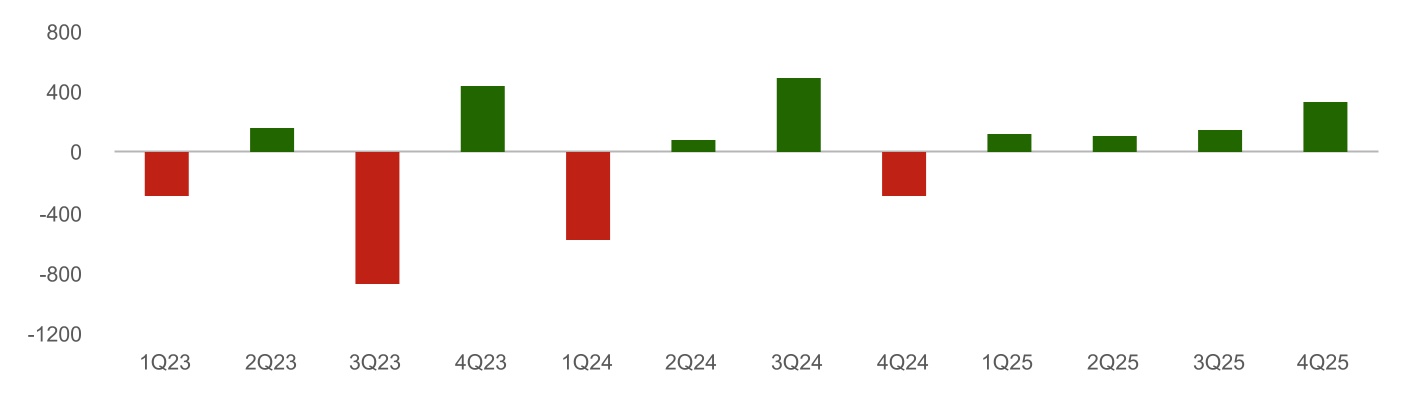
Given the significant increase in commodity prices between December 31, 2025, and March 31, 2026, the change in the timing effects from fourth quarter is approximately ($4.9) to ($3.5) billion. Approximately ($0.8) to ($0.2) billion is reflected in Upstream earnings related to natural gas transactions. Approximately ($4.1) to ($3.3) billion is reflected in Energy Products earnings related to transactions for crude and finished products. The midpoint of the first-quarter 2026 timing effects represents approximately $0.93 per share5.
In addition, the quarter-end cash balance will reflect outflows related to these timing effects due to cash margin postings of comparable value.
Identified items
As noted, physical shipments of hydrocarbons are often hedged with financial derivatives in the normal course of business. Supply disruptions in the Middle East prevented the physical shipment associated with several hedges in the first quarter. The resulting earnings impact of ($0.8) to ($0.6) billion is isolated within Identified Items in the Earnings Considerations.
3 Brent prices shown are the historic second-month forward prices at the end of each quarter, sourced from Bloomberg. Actual underlying commodity prices for ExxonMobil reported timing effects vary.
4 Timing effects shown for 2023 have been adjusted to reflect ExxonMobil’s current timing effects reporting basis.
5 Per-share calculation is estimated using an assumption of 4.2 billion average shares outstanding for the first quarter.
2
Look ahead
ExxonMobil is leveraging the strength of its integrated global system to support customers. We are increasing Permian production to 1.8 million oil-equivalent barrels in 2026, optimizing logistics and crude and product flows, and maximizing refinery throughput wherever safe and feasible.
In addition, Golden Pass LNG, a joint venture between QatarEnergy and ExxonMobil, achieved first production of Liquefied Natural Gas (LNG) from Train 1 at its Sabine Pass terminal on March 30, 2026. This marks a significant milestone in our partnership with QatarEnergy, underscoring the strong foundation we have built together and our shared commitment to long-term value creation and increased global supply.
These actions reflect the Company’s unmatched scale, integration, and execution capability, which enable ExxonMobil to respond effectively to market disruptions.
Forward-looking statements. Outlooks, estimates, projections, and other statements of future financial impacts of certain factors as provided in this publication are forward-looking statements within the meaning of the Private Securities Litigation Reform Act. Actual future impacts of these certain factors for 1Q 2026 may vary from our estimates for a number of reasons, including additional unidentified factors related to: sales volume and sales mix numbers; supply and demand imbalances or changes including as a result of direct or indirect restrictions on production or escalating geopolitical volatility; regional pricing differentials and refining and chemical margins; fluctuations in feedstock prices; forecasts of economic growth or downturn; seasonal impacts on product demand and operating expenses; resolution of trading and derivative positions for the quarter; increases in integration benefits or costs of new start-ups or acquisitions; global and regional hostilities, including decoupling of economies, national or regional tariffs, trade disputes, border disputes, nationalizations, war, terrorism, threats to trade routes or freedom of navigation, or civil unrest and its impact on markets and our assets around the world; price impacts and the broader government responses to inflationary pressures; changes in interest and exchange rates; supply chain, shipping channel and trade network disruptions; planned cash and operating expense reductions; total capital expenditures and mix; maintenance costs and incidents; production shut-ins and mix; financing costs; the resolution of any contingencies and uncertain tax positions; environmental expenditures; impact of fiscal, contractual, and commercial terms applicable to the quarter; the outcome of commercial negotiations related to the quarter; the timing and regulatory approval of any acquisitions or divestments; regional differences for product demand; changes in consumer behavior including the impact of inflation and/or recession; actions by governments, independent administrative bureaucracies, international bodies or non-governmental organizations to increase our costs, decrease our ability to produce or replenish reserves, prohibit the export or sale of our products, or prevent the expansion of our low carbon solutions businesses; changes in asset valuation or estimates of fair value as of a certain date; updates or corrections of any estimate used herein; and other market conditions in or impacting the oil, natural gas, petroleum, and petrochemical industries. Furthermore, additional factors may exist that will be relevant to 1Q 2026 results that are not currently known or fully understood, including our participation in joint ventures or developments operated by third parties and other factors cited in Item 1A. Risk Factors of our most recent Annual and Quarterly Reports available on the Investors page of our website at www.exxonmobil.com. All forward-looking statements and the assumptions in this filing speak only as of the date hereof. We do not assume or undertake any obligation to update these forward-looking statements or assumptions as of any future date. Any future update or expansion of the forward-looking statements in this filing will be provided only through a public disclosure indicating that fact.
Earnings (loss) excluding Identified Items, are earnings (loss) excluding individually significant non-operational events with, typically, an absolute corporate total earnings impact of at least $250 million in a given quarter. The earnings (loss) impact of an Identified Item for an individual segment in a given quarter may be less than $250 million when the item impacts several segments or several periods. Management uses these figures to improve comparability of the underlying business across multiple periods by isolating and removing significant non-operational events from business results. The Corporation believes this view provides investors increased transparency into business results and trends, and provides investors with a view of the business as seen through the eyes of management. Earnings (loss) excluding Identified Items is not meant to be viewed in isolation or as a substitute for net income (loss) attributable to ExxonMobil as prepared in accordance with U.S. GAAP. In accordance with Regulation FD, we are hereby providing notice the Company currently intends to furnish its 1Q 2026 financial results both (1) by posting them on our website at www.exxonmobil.com and (2) in a filing on Form 8-K in the Securities and Exchange Commission EDGAR system, each at approximately 5:30 a.m. CT Friday, May 1, 2026. In the event the EDGAR system experiences technical difficulties, or the Company is unable to successfully complete its 8-K filing at the intended time, investors and the public should look for this information at that time on our website. In case of a failed filing, the Company intends to furnish the information on EDGAR as soon as possible after 5:30 a.m. CT Friday, May 1, 2026.
3